Is 3x Rent Enough? What It Leaves You After Taxes
Is 3x rent enough to live on? A $1,500 apartment passes 3x at $54,000 a year, but rent eats about 42% of take-home pay. See the real monthly math.
By the 3xRentCalculator.com team
Is 3x rent enough? For getting approved, usually yes. As a budget it is thinner than it looks: at $1,500 rent and $4,500 a month of gross income, rent takes 33.3% of gross pay and closer to 42% of what actually lands in your account.
Passing the landlord’s test and affording the apartment are two different questions. The multiplier only answers the first.
What 3x leaves after taxes and payroll deductions
Start with the standard example. $1,500 a month of rent under the 3x rule needs $4,500 a month of gross income. That is $54,000 a year, or $25.96 an hour at 40 hours a week. The $1,500 rent page lays out that math.
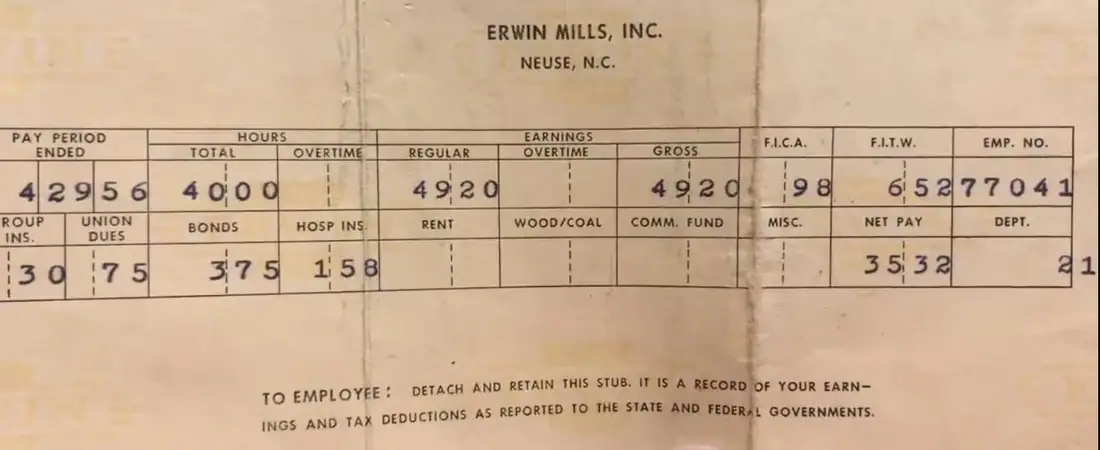
Gross income is where the rule stops. Your paycheck keeps going.
Payroll tax comes out first. Social Security and Medicare take 7.65% of wages on the employee side, about $344 of that $4,500. FICA applies in every state.
Federal income tax withholding follows, then state income tax in most states and city tax in a few places. The total depends on your filing status, your state and your pre-tax deductions, so treat it as a range. Take-home pay on $54,000 usually falls somewhere around $3,400 to $3,800 a month. The IRS Tax Withholding Estimator will give your own figure.
Now put $1,500 of rent against that.
| Monthly figure | Amount |
|---|---|
| Gross income | $4,500 |
| Rent | $1,500 |
| Rent share of gross | 33.3% |
| Take-home pay, typical range | $3,400 to $3,800 |
| Rent share of take-home | 39% to 44% |
| Left after rent | $1,900 to $2,300 |
Health premiums and retirement contributions shrink it again. A $200 insurance premium plus 5% into a 401(k), which is $225 here, pulls another $425 off the top. Gross vs net income covers why landlords screen on the bigger number anyway.
The gap between qualifying and affording
Qualifying answers the landlord’s question: are you likely to pay? Affording answers yours: does paying leave enough for the rest of your life?
At exactly 3x, that $1,900 to $2,300 has to cover utilities, groceries, transport, phone, insurance, debt and savings. In a low-cost metro with no car payment, it works. With a commute, a car loan and student loans, it does not.
The 3x rule never asks. It is one multiplication on one number, done in about four seconds.
The 30% rule is tighter and still only looks at gross income. Neither rule knows a thing about your bills.
Debt payments the multiplier ignores
Two renters each earn $4,500 a month. One has no debt. The other pays $450 on a car and $300 on student loans.
Both clear 3x on a $1,500 apartment. One of them has $750 a month less to live on.
Lenders solved this decades ago with the debt-to-income ratio, which counts every monthly payment against income instead of just the housing cost. Most rental screening skips it and looks at income and credit alone.
So run the lender’s version on yourself. Add the rent to your monthly debt payments, then divide by gross monthly income. Mortgage lenders have long treated a combined ratio above roughly 43% as a warning sign, and the same logic holds for rent. In the example, $1,500 of rent plus $750 of debt against $4,500 is 50%.
That applicant passes 3x and is still overextended.
When 3x is too loose and when it is too strict
Too loose at low incomes
The percentages hold at any income. The dollars do not.
Scale the example down to $900 rent. The 3x rule asks for $2,700 a month of gross income, or $32,400 a year. Take-home is roughly $2,250 to $2,400, so about $1,350 to $1,500 is left after rent. Same ratio, far less slack.
Push it further and the rule stops making sense. A full-time job at the federal minimum wage pays $15,080 a year, which is $1,256 a month, and 3x allows rent of about $419. There is almost nothing in the country at that price, and what is left over would not cover basics anyway.
Too strict in expensive markets
Where rents are high relative to wages, a flat 3x screens out people who would pay on time. That is why softer cutoffs exist. Check what 2 times the rent means and what 2.5 times the rent means for the thresholds landlords use instead.
3x is also a poor fit for renters with large savings, retirees living on assets, and anyone who has paid that same rent for years with a clean record. Those cases are judgment calls, and 8 ways to get approved without 3x income walks through how to make them.
A quick budget check to run before you apply
- Take a recent pay stub and find net pay, then convert it to a monthly figure.
- Subtract the rent.
- Subtract fixed costs: debt payments, insurance, transport, childcare, phone, subscriptions.
- Subtract utilities if the lease does not include them. The amount swings with climate, unit size and what the landlord covers, so use your own past bills if you have them.
- Whatever is left is food, savings and anything unplanned.
If step 5 lands under a few hundred dollars, the apartment is too expensive no matter what the multiplier says. One car repair resets your whole year.
What to aim for if you want breathing room
3x is a ceiling, not a goal. Here is what the same $1,500 apartment looks like at other multipliers.
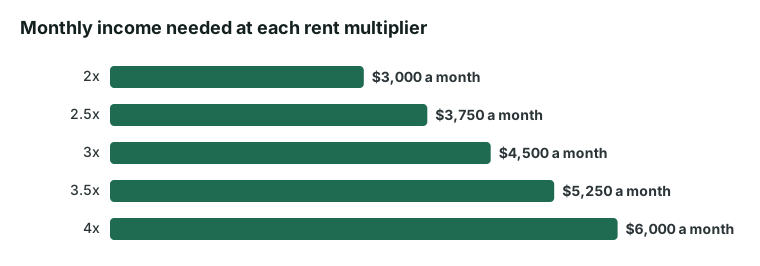
| Multiplier | Gross income needed | Yearly | Rent share of gross |
|---|---|---|---|
| 2x | $3,000 a month | $36,000 | 50% |
| 2.5x | $3,750 a month | $45,000 | 40% |
| 3x | $4,500 a month | $54,000 | 33.3% |
| 3.5x | $5,250 a month | $63,000 | 28.6% |
| 4x | $6,000 a month | $72,000 | 25% |
At 4x, or $72,000 a year, rent is a quarter of gross pay and roughly 40% of take-home goes to everything else before you touch savings. That is the level where a car payment and a student loan stop hurting.
If you are already at 3x and signing anyway, protect yourself in the other direction: keep utilities low, avoid new debt during the lease, and build a cushion of two or three months of rent before you move.
Run your own numbers
The 3x rent calculator on the 3xRentCalculator home page turns any rent into the gross monthly income, yearly salary and hourly wage it takes to pass. Enter your rent, then compare the result with your actual net pay and your fixed bills before you fill out an application.
Frequently asked questions
Is 3x rent enough to live on?
It is enough to get approved and tight as a budget. At $1,500 rent and $4,500 a month of gross income, rent is 33.3% of gross but around 39% to 44% of take-home pay once payroll and income taxes come out. That leaves roughly $1,900 to $2,300 for everything else, before any debt payments.
Is 3x rent standard?
It is the most common screening rule in the United States, but it is not a law or a national standard. Landlords set their own cutoff. Some use 2x or 2.5x in expensive markets, some ask for 3.5x, and New York City landlords usually want a yearly income of 40 times the monthly rent.
Should you make 3 times your rent?
Treat 3x as the floor for approval, not the target for comfort. If you carry a car payment or student loans, or utilities are not included, aim for 3.5x to 4x. At $1,500 rent that is $5,250 to $6,000 a month of gross income, which puts rent near 25% to 29% of pay instead of 33.3%.
Why do people say 3 times the rent should be illegal?
Because the same ratio squeezes low earners far harder than high earners, and it can block applicants who have paid that exact rent for years. Federal law sets no multiplier, so a landlord may pick one, as long as it is applied the same way to every applicant and is not used to exclude protected classes.