When Did the 3x Rent Rule Start? A Short History of the Number
When did the 3x rent rule start? There is no founding date. Trace it from the 25% public housing cap to the 30% standard to today's screening software.
By the 3xRentCalculator.com team
When did the 3x rent rule start? There is no founding date and no law that created it, but the share of income behind it comes from federal housing policy: a 25% cap on public housing rent in 1969, raised to 30% in 1981. Private landlords turned that share into a multiplier, and computerized screening made the number standard.

So the honest answer has two halves. The percentage has a paper trail. The multiplier does not.
The rent guidelines that came before 3x
Before any fixed share existed, rent advice was folk wisdom passed between tenants. One old rule of thumb held that a week’s pay should cover a month’s rent, which works out to roughly a quarter of income.
Early federal housing law did use a ratio between income and rent, but it ran the other direction. Public housing created by the Housing Act of 1937 limited who could move in, and those income limits were written in relation to the rent. Earning too much compared with the rent could disqualify a family. The arithmetic looked familiar. The purpose was the opposite of screening for ability to pay.
In the private market of that era, landlords judged applicants on references, steady work and their own read of the person. There was no standard number, which also meant there was nothing to hold a landlord to.
How federal housing policy set a share-of-income standard
The share-of-income idea became policy in 1969 with the Brooke Amendment, which capped rent in federal public housing at 25% of a tenant’s income. In 1981 Congress raised that cap to 30%.
Thirty percent then spread far beyond public housing. Federal statistics call a household cost burdened when housing takes more than 30% of income, and severely cost burdened above 50%. HUD’s research office reviews the history and the criticism in Rental Burdens: Rethinking Affordability Measures.
The same share runs the voucher program. A household with a Housing Choice Voucher pays about 30% of adjusted income toward rent and utilities, and the subsidy covers the gap.
Once a single number carried that much official weight, it was available to anyone who needed a cutoff.
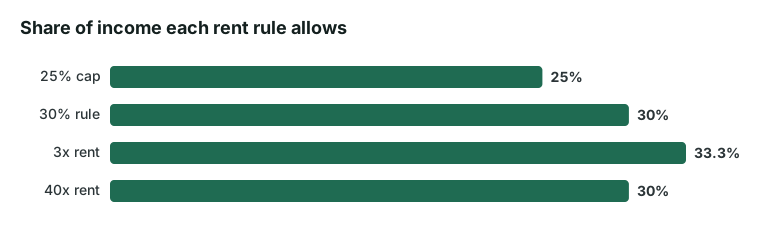
| Rule | Share of income it allows | Where the number comes from |
|---|---|---|
| 25% cap | 25% | Public housing cap, 1969 |
| 30% rule | 30% | Cap raised in 1981, now the federal cost burden line |
| 3x rent | 33.3% | Landlord practice, no statute |
| 40x rent | 30% | New York City custom, same math as the 30% rule |
When landlords flipped the share into a multiplier
Ask when 3 times the rent started and the trail goes cold right here. No agency announced it and no trade group published it. It appears in listings and applications as something everybody already knew.
What can be explained is the shape of it. A landlord screening applicants does not start with an income and ask what rent fits. They start with the rent, which is fixed, and ask what income clears it. That reverses the fraction, and 30% reversed is 3.33 times the rent.
Rounding down to 3 made it usable. Dividing by three is mental math you can do at a showing. The 30% rule compared with the 3x rule shows how little daylight sits between them.
Take the standard case. A $1,500 apartment under the 3x rule needs gross income of $4,500 a month, which is $54,000 a year, or $25.96 an hour at 40 hours a week. Under a strict 30% test the same unit would need $5,000 a month, or $60,000 a year. The multiplier is slightly kinder to the applicant and much faster to apply.
Screening software and why the number stuck
The rule hardened when screening stopped being a conversation and became a report. Credit files and rental history reports are consumer reports, governed by the Fair Credit Reporting Act passed in 1970.
Tenant screening services and, later, online rental platforms needed criteria they could store in a field. A percentage of income needs context. A multiple of rent is one number that fits any unit in any portfolio.
A flat multiple also looked safer legally. A landlord who applies the same test to every applicant has an easier time explaining the decision than one who judges case by case, which is part of why a landlord can require 3 times the rent in most places today.
Then the number reproduced itself. Property managers copied the listings they read, applicants stopped applying below the line, and 3x became the default nobody chose.
What has changed since the rule became standard
The multiplier has not moved. Almost everything around it has.
Rents in many metros have climbed faster than pay, so the income the rule demands now sits well above what common jobs offer. That $25.96 an hour for a $1,500 apartment is several times the federal minimum wage.
Household shapes changed too. The rule was built around one earner, and today it is routinely applied to roommates, gig income and multiple part-time jobs at once.
The legal floor has shifted in places. A growing list of states and cities protect source of income, and some require the test to be applied to the renter’s share of the rent rather than the full rent when a voucher is involved. The guide on new laws and bills on income requirements tracks where that stands.
What has not happened is a replacement. No agency has set a different multiple, so the number from landlord shorthand is still the one most applications run on.
See the number for your rent
History explains the rule. Arithmetic tells you whether you pass it. The 3x rent calculator takes any rent and returns the monthly income, yearly salary and hourly wage the rule asks for.
Frequently asked questions
Who invented the 3x rent rule?
No one person or agency did. There is no patent, statute or founding document behind it. The 30% share of income it echoes came from federal public housing policy, and private landlords turned that share into a multiplier because dividing rent by three is easy to do in your head. The number spread by copying, not by decree.
Is the 3x rent rule a law?
No. No federal law sets an income multiple for private rentals, and most states do not either. It is a screening policy a landlord chooses. Some states and cities now limit how it can be applied, mainly for renters using housing assistance, but the test itself remains legal in most of the country.
Why 3x the rent and not 2x or 4x?
Three sits closest to the 30% affordability standard while staying simple. Rent at exactly 3x income works out to 33.3% of gross pay, a little looser than 30%. At $1,500 a month of rent, 3x asks for $4,500 a month in gross income, or $54,000 a year. A 4x test would ask $72,000, which few applicants in that price range would clear.