3 Times Income for Rent: How Much Rent You Can Afford on Your Monthly Pay
3 times income for rent means divide your monthly pay by 3. See the rent you qualify for on $3,000 a month, plus what to do when your limit is too low.
By the 3xRentCalculator.com team
3 times income for rent means rent can take no more than a third of your gross monthly pay, so you divide your monthly income by 3 to get the rent you qualify for. If you make $3,000 a month, that is $1,000 of rent. Landlords run the same arithmetic in the other direction, and the 3x rent rule covers how they apply it to an application.

Most rent pages start from an apartment and solve for the salary. This one starts from your paycheck.
What 3 times income for rent means when you start from your pay
The landlord’s wording is that your income has to be at least 3 times the rent. Turn it around and the same rule says your rent can be at most your income divided by 3.
One test, two directions. The landlord multiplies, you divide.
The income in the test is gross income, your pay before taxes, insurance and retirement come out. It is the top line of a pay stub and the number on an offer letter. The term has a settled meaning outside renting too, where gross income is income before deductions.
A small share of landlords use take-home pay instead, which is a much harder test to pass, so gross or net income on an application is worth reading before you pay a fee.
How do you turn your monthly income into a maximum rent?
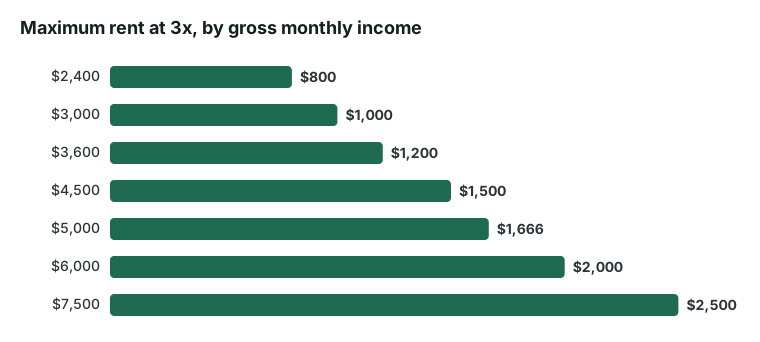
Divide your gross monthly income by 3. The result is the highest rent you can be approved for under the 3x rule. If two people will sign the lease, add both gross incomes first, then divide. The answer is a ceiling, not a target.
- Take your gross monthly pay, before any deductions.
- Add the documented gross pay of anyone else signing the lease.
- Divide the total by 3.
- Compare the result with the rent on the listing, including any fixed monthly fees.
| Gross monthly income | Yearly income | Hourly at 40 hours | Max rent at 3x |
|---|---|---|---|
| $2,400 | $28,800 | $13.85 | $800 |
| $3,000 | $36,000 | $17.31 | $1,000 |
| $3,600 | $43,200 | $20.77 | $1,200 |
| $4,500 | $54,000 | $25.96 | $1,500 |
| $5,000 | $60,000 | $28.85 | $1,666 |
| $6,000 | $72,000 | $34.62 | $2,000 |
| $7,500 | $90,000 | $43.27 | $2,500 |
The hourly column uses 2,080 hours a year, which is 40 hours a week for 52 weeks.
Example: the rent you qualify for on $3,000 a month
Say your gross pay is $3,000 a month. Divide by 3 and your rent ceiling is $1,000.
That income is $36,000 a year, or $17.31 an hour at 40 hours a week.
Now take the apartment at the center of most of these questions. A $1,500 apartment needs $4,500 a month of gross income under the 3x rule, which works out to $54,000 a year or $25.96 an hour. At $3,000 a month you are $1,500 short of that every month, so a $1,500 listing is out of reach on your income alone.
The size of that gap decides your next move: a roommate, a co-signer, or a cheaper listing.
Hourly pay, biweekly checks, and income that moves around
Hourly pay becomes a monthly figure in one step. Multiply your rate by 40, then by 52, then divide by 12. What salary do I need for 3x rent runs the same math in reverse, from a wage to the rent it supports.
Biweekly and semimonthly checks
Biweekly pay trips people up. You get 26 checks a year, not 24, so doubling one check understates your monthly income by about 8%. Multiply one check by 26 and divide by 12 instead.
Semimonthly pay is different. That is 24 checks a year, so two checks really does equal one month.
Income that changes month to month
When your pay moves around, landlords work from an average. Some ask for three months of pay stubs, some for a full year, some for last year’s tax return.
There is no single standard here, so ask what period they average before you hand anything over, and bring the documents that show your stronger months.
Overtime, tips and bonuses usually count only when you can show a history of them.
The rent you qualify for vs the rent you can live with
Your 3x ceiling is a screening result. It says a landlord is likely to approve you. It says nothing about whether the rent fits your life.
Two things eat into it.
The first is taxes. A third of gross pay is a larger share of the money that actually lands in your account, and how much larger depends on where you live. Is 3x rent enough works through what is left after withholding.
The second is everything rent does not cover. If utilities, parking or a pet fee are billed on top, your real housing cost is higher than the number you divided by 3. Which charges count as rent explains what landlords fold into the test.
Debt is the blind spot neither rule catches. Two renters earning $3,000 a month both qualify for $1,000 of rent, even if one of them pays $600 a month on a car loan. The rule cannot see that. Your budget can.
What to do when the place you want is above your limit
The ceiling moves when more income or more security joins the application.
- Add a roommate to the lease. The incomes are added together before the division.
- Ask whether a co-signer or guarantor can meet the requirement on your behalf.
- Offer a larger deposit, up to the cap your state sets.
- Show savings. Several months of rent in the bank answers the same worry the ratio does.
- Look for landlords with a lower multiple. Some use 2.5 times the rent, and smaller landlords often set no ratio at all.
What if you don’t make 3 times the rent goes through how those exceptions tend to get approved.
It also helps to know where the 3 comes from. It sits close to the federal affordability line of 30% of income, which HUD’s research office describes in Rental Burdens: Rethinking Affordability Measures.
Check your number both ways
Divide your gross monthly pay by 3 to get your rent ceiling. Then put that rent into the 3x rent calculator on the home page to see the income, salary and hourly wage a landlord would look for at that price, and confirm the two numbers meet.
Frequently asked questions
If I make $3,000 a month, how much should my rent be?
Divide $3,000 by 3. Under the 3x rule your rent ceiling is $1,000 a month. That is what a landlord using the test will approve, not a budget. After taxes, $1,000 takes a bigger bite out of the money that reaches your account, so check it against your take-home pay before you sign.
Should my income be 3 times the rent before or after taxes?
Before taxes, in most cases. The figure landlords want is gross income, which is the top line of a pay stub and the salary on an offer letter. A smaller number of landlords use take-home pay, and that version is much harder to pass. Ask which one a listing means before you pay an application fee.
What salary do I need for $1,500 rent?
A $1,500 apartment needs $4,500 a month of gross income to pass the 3x rule. Over a year that is $54,000, or $25.96 an hour at 40 hours a week. If two people sign the lease, the two incomes are added together, so the household has to reach $4,500 between them.
How do I turn an hourly wage into a rent limit?
Multiply your hourly rate by 40, then by 52, then divide by 12 for gross monthly pay. Divide that by 3 for your rent ceiling. At $17.31 an hour the math runs $36,000 a year, $3,000 a month, and a $1,000 rent limit. Overtime counts only if you can document a history of it.